What this service covers
Fan-driven systems designed for the foundation in front of you: a poured Carmel basement, a Speedway bungalow cellar, a Greenwood crawl, or the mix of all three that central Indiana remodels produce. Indiana ties its mitigator license to a current NRPP or NRSB national certification, so every install here follows the ANSI/AARST SGM-SF-2023 soil gas mitigation standard, and every job ends with a post-install verification test.
Typical pricing
$1,100-$2,200
Pricing varies by job specifics. Free phone or on-site quotes; fixed pricing once the technician has assessed the job.
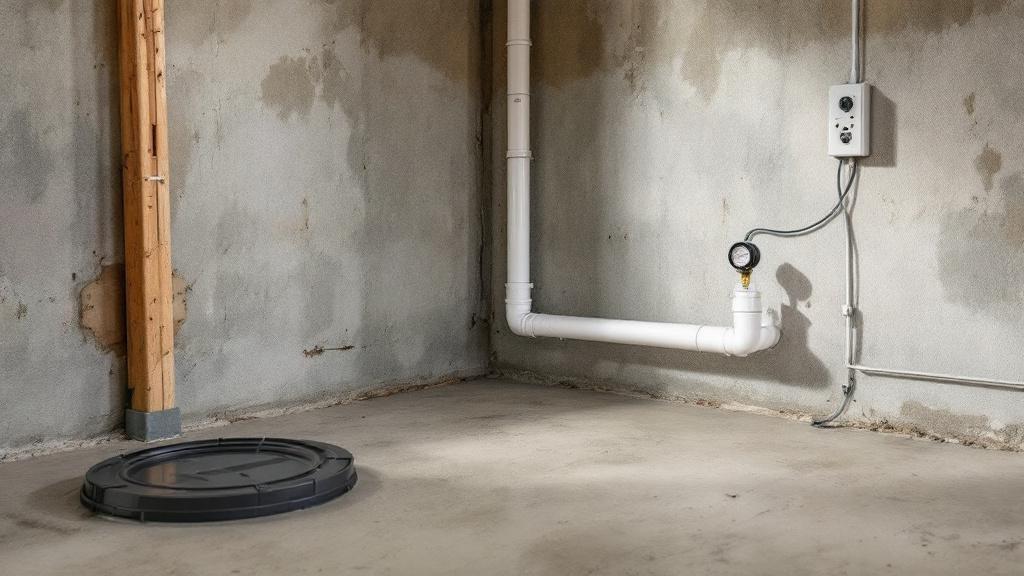
What an active radon system does under an Indianapolis house
Soil gas moves toward low pressure, and a heated house is the low-pressure side of its own foundation for most of a central Indiana year. Stack effect pulls air up and out of the upper floors, replacement air gets drawn from the easiest source available, and in a basement or crawl space the easiest source is the dirt. A mitigation system reverses the contest. A suction pit cored through the slab, or a sealed membrane laid over a crawl floor, gives a continuously running fan its own grip on the soil, so the pressure under the house stays lower than the pressure inside it and the gas rides the pipe past the roofline instead of seeping through the floor.
The reason the approach dominates is the published performance. The EPA's Consumer's Guide to Radon Reduction credits active sub-slab suction with reductions of 50 to 99 percent, against 30 to 70 percent for a passive pipe, which is why sealing, ventilation, and passive pipes are treated as helpers rather than fixes. The fine print of a good install is local: how far suction reaches under a given slab depends on what the builder put beneath it, and a 1960s Lawrence ranch with rubble fill behaves nothing like a 2015 Fishers basement sitting on washed gravel.
That is what diagnostics are for. A smoke stick and a drilled test hole at the far corner of the slab show whether one suction point will carry the whole floor before anyone commits to it, and a house that needs two points should learn that from a manometer reading, not from a disappointing retest. Our pricing guide shows how those findings move a quote.
Who is allowed to install a radon system in Indiana
Indiana regulates the people rather than publishing its own installation code. Under IC 16-41-38 and the rules in 410 IAC 5.1, anyone paid to do radon work in Indiana must hold a license from the Indiana Department of Health, and the mitigation license comes with a second requirement: the licensee must also hold a current national proficiency certification from NRPP or NRSB. Those certifications are what bind the work to the national consensus standard, ANSI/AARST SGM-SF-2023, which governs where the fan may sit, how the discharge terminates above the roof, how sump pits are sealed, and how the finished system is labeled and gauged.
The practical consequence for a homeowner is pleasant: the paper trail is short and checkable. IDOH publishes its list of certified radon testers and mitigators, so a license claim takes about two minutes to verify, and the NRPP and NRSB registries confirm the national certification behind it. All mitigation pros you work with here hold the Indiana license and a current national certification.
One more Indiana wrinkle worth knowing before you sign anything: the state licenses testers in tiers. A secondary tester may place and retrieve passive devices, such as charcoal canisters, that a certified lab analyzes; a primary tester may also measure with active continuous monitors. Ask which kind of device your post-install test will use and who holds the license behind it. The license guide walks through every category, and how to verify a license shows the lookup step by step.
How central Indiana foundations shape the design
Indianapolis is a crawl space town in a way the newer suburbs are not, and that single fact drives more system design here than the geology does. The pre-war neighborhoods, Irvington, Broad Ripple, Fountain Square, and the old cores of Franklin and Noblesville, run to shallow cellars and brick-pier crawls; the postwar rings of Lawrence, Beech Grove, and west Greenwood add thousands of crawl-space and slab ranches; and the donut-county subdivisions of Carmel, Fishers, Avon, and Westfield swing back to poured basements, many with a builder's passive stub already in a chase.
Each foundation gets its own tool. Basements and slabs take sub-slab suction. Crawls take a sealed membrane with the fan drawing from beneath it, because depressurizing bare dirt is not possible and venting it louder is not mitigation. The hard houses are the hybrids, a bungalow with a slab addition or a basement house with a crawl under the family room, where one fan may serve two foundations if the diagnostics say the pipe runs can meet.
Underneath all of it sits the reason the region tests high at all: the New Albany Shale subcrop beneath northwest and west-central Marion County and the uranium-bearing glacial till spread over the rest. The county data page has the numbers by county.
Service area
Radon Mitigation Systems is available across Indianapolis and central Indiana. Per-suburb pages: