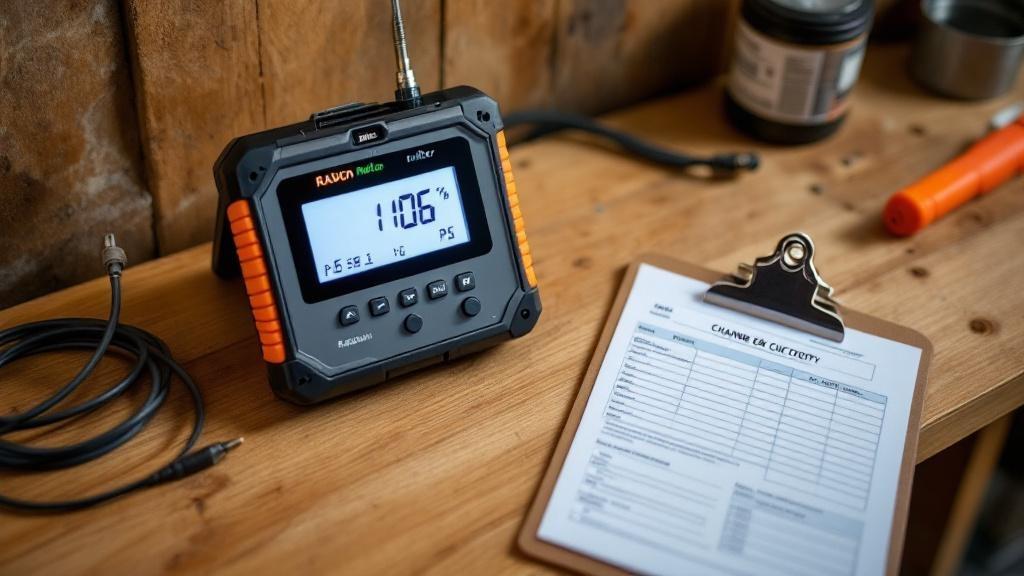
What this service covers
Professional radon measurement for first screenings, home sales, and post-mitigation verification. Indiana requires anyone paid to test to hold an IDOH tester license, and the state splits that license into tiers: secondary testers place passive devices that a certified lab analyzes, and primary testers may also run continuous monitors. Reports list the device, the placement, the start and stop times, and the license number behind the number.
Typical pricing
$140-$280
Pricing varies by job specifics. Free phone or on-site quotes; fixed pricing once the technician has assessed the job.
Which radon test answers which question
A short-term test, two to seven days for most devices, answers the question a deadline asks: what is this house doing right now, under closed conditions. It is the only practical choice inside a purchase inspection window, and it is the right first move for any homeowner who has simply never tested. Charcoal canisters, electret chambers, and continuous monitors all live in this category, and a continuous monitor adds something the passive devices cannot: an hourly trace that shows whether the result was steady or spiked with a weather front.
A long-term test, 90 days or more with an alpha-track detector, answers the better question when nobody is rushing you: what do the people in this house actually breathe across the seasons. Radon swings with weather and with how a house is run, and central Indiana's swing is seasonal, higher through the months the furnace runs and the windows stay shut. A borderline short-term result, say 3 or 5 pCi/L, is exactly the case where a detector set out in late fall and collected after winter earns its keep.
Neither type outranks the other; they are different instruments for different decisions. The side-by-side comparison lays out cost, timing, and when each is the wrong tool, and the EPA's citizen guidance underpins the decision points on both sides.
Placement and conditions that make a result stand up
Most bad radon numbers are placement mistakes before they are anything else. A test device belongs in the lowest level of the home that is lived in or could be, in a real room rather than a kitchen, bathroom, laundry, or closet, off the floor, away from exterior walls, drafts, sunlight, and heat sources, and far enough from the sump that it reads the room instead of the pit. In an Indianapolis crawl-space house, that means the device goes in the living space above the crawl, not down on the dirt; the crawl is a pathway, not an occupied level.
Closed-building conditions are the other half. For short tests, windows stay shut and exterior doors open only for coming and going, starting 12 hours before the device does and holding through the whole measurement, with heating or cooling running normally. The convention exists to make results comparable and conservative, and it is why a January test in Greenfield and a July test in the same house are not the same evidence.
Real estate adds formality: devices in tamper-resistant placements, a noninterference understanding with whoever occupies the house, and a report that documents conditions. Indiana requires the person conducting a paid test to be IDOH-licensed, and the report should carry that license number; if it does not, ask why. See what a report should contain.
Acting on a central Indiana radon result
The EPA's action framework is short enough to memorize. At 4.0 pCi/L or higher, fix the home. Between 2 and 4, consider fixing, because no level is risk-free and the average outdoor background is around 0.4. Below 2, retest every couple of years and after any change to the foundation, the HVAC, or how the lowest level is used.
What makes the framework bite locally is how often central Indiana results land in the upper bands. The Indiana Department of Health's statewide results for 2002-2022 put Marion, Hamilton, Hendricks, and Johnson counties in the band where 25 to 50 percent of tested homes logged at least one result at or above 4.0 pCi/L, and an AARST summary of 2008-2017 lab data found 39 percent of 43,148 Indiana tests above the action level. A high first result deserves one confirmation before anyone cores a hole: either a second short-term test, averaged with the first, or a long-term test if time allows.
From there the path is procedural. A confirmed number at or above 4 means a written mitigation scope, an install by an IDOH-licensed mitigator, and a retest after the fan has run. Start with the cost FAQ for ranges, or the diagnosis page if you are deciding what to do first.
Service area
Radon Testing is available across Indianapolis and central Indiana. Per-suburb pages: